
Class 11PhysicsSystem of Particles and Rotational MotionConservation of angular momentum (combined translation and rotational motion)
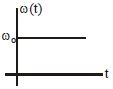
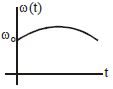
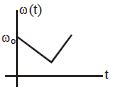
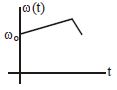
Difficult$A$ circular stage is free to rotate about a vertical axis passing through its centre. $A$ tortoise is sitting at the corner of the stage. The stage is provided with an initial angular velocity $\omega_0$. If the tortoise starts moving along one chord at a constant speed with respect to the stage,then how does the angular velocity of the stage $\omega(t)$ vary with time $t$?
- A
- B
- C
- D
Explore More
Similar Questions
An ice block is placed at the center of a circular table. The system is rotated about the axis of the table with an angular velocity $\omega$. If the ice starts melting without evaporation,the rotational speed of the system will:
Medium
View Solution$A$ rotating table completes one revolution in $10 \ s$. Its moment of inertia is $100 \ kg \cdot m^2$. $A$ man of mass $50 \ kg$ stands at the center of the rotating table. If the man moves $2 \ m$ away from the center,what will be the angular velocity of the table in $rad/s$?
Medium
View SolutionIn the absence of torque,the rotational frequency of a body changes from $1 \text{ cy/sec}$ to $16 \text{ cy/sec}$. The ratio of the radius of gyration in the two cases will be: (in $: 1$)
Medium
View SolutionAccording to the principle of conservation of angular momentum, angular momentum:
Easy
View SolutionTwo discs of moments of inertia $I_1$ and $I_2$ about their respective axes (normal to the disc and passing through the centre),and rotating with angular speed $\omega_1$ and $\omega_2$ are brought into contact face to face with their axes of rotation coincident. What is the loss in kinetic energy of the system in the process?
Difficult
View SolutionVedclass Products
For Students
Vedclass Test Series
Mock tests in real JEE/NEET style with performance analysis. 5-day free trial.
Start Free TrialFor Teachers
Exam Paper Generator
Generate Set A/B/C/D exam papers from 7.5L+ questions in 2 minutes. 3 chapters free.
Try FreeFor Institutes
Online Exam Module
Live online exams with unlimited students, 360° analytics & white-label branding.
See Demo